By
Jennifer M McPherson
I believe there is a deep and undeniable intersection between mental health and spirituality. In fact, I believe some of the most powerful explanations for the mental health challenges that plague our society are found right within Scripture itself.
Much of our difficulty lies in our misunderstanding of the soul—our mind, will, and emotions—and how these work in union with both the spirit and the body. We tend to compartmentalize the human person, separating what was never meant to be divided. Yet when Christ speaks in Isaiah 61 about why He came and why the Spirit of the Lord was upon Him, He is revealing something far more comprehensive than we often acknowledge. He speaks about the whole person being made well.
We love to quote Scriptures about physical healing. We celebrate stories of bodies being restored. But what I have noticed—both in my own life and within the church—is that we often shy away from the mental and emotional dimensions of healing. We avoid the soul.
And yet, when Christ came to make our spirit alive, He also made provision for our soul to be healed. This is not an optional add-on to salvation; it is part of the invitation.
WHY THE CHURCH HAS AVOIDED THE SOUL
As sons and daughters of God, we were never meant to outsource humanity’s deepest questions to the world alone. We were created to carry answers, rooted in divine truth and embodied in lived experience. But because the soul cannot be managed by religious formulas or controlled by dogma, we often retreat from engaging it fully.
Instead, we swing to extremes.
On one side, we leave mental and emotional health entirely to logic-based frameworks, valuable in many ways but often disconnected from spiritual identity and meaning. On the other side, we choose a hyper-spiritual approach that is so vague and idealistic that it becomes impossible to apply. We can talk about it endlessly, but people leave unchanged, still fragmented, still searching.
Neither extreme brings life.
When Jesus said, “To those who received Him, He gave the right to become children of God,” He was not offering religious language as a hiding place. Yet we often use that very language to stay comfortable. Vague symbolism allows us to avoid weight, responsibility, and honest self-examination.
HEALING IS RELATIONAL, NOT MAGICAL
One of the most damaging ideas we have absorbed is that healing should be instantaneous. As though walking into a room automatically resolves years of trauma and fragmentation.
For those who have experienced deep trauma, the soul is often shattered or segmented. Participation in life and connection with others can feel unsafe. Yet we tell people to simply show up and expect healing.
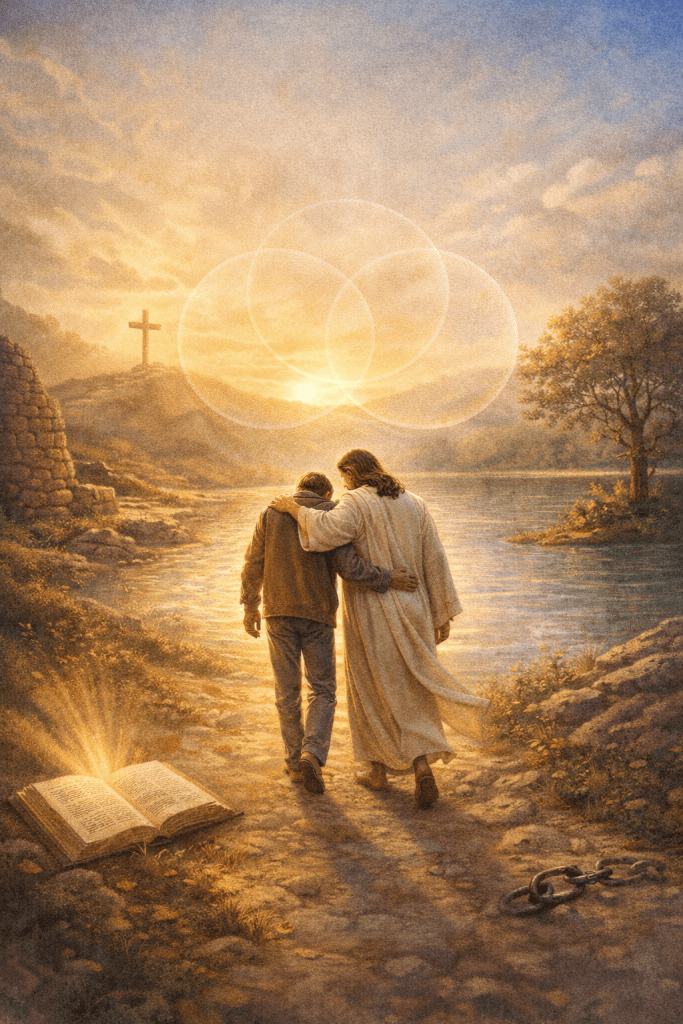
But the Spirit of God heals us by walking with us.
Psalm 23 tells us that He leads us beside still waters, where the soul is restored. Healing unfolds in safety, intimacy, and time.
This is why people can attend church for decades and still feel unchanged. Healing is available, but it requires participation. The door is open, but we must be willing to sit with the Lord in uncomfortable places and allow Him to speak truth where coping once lived.
THE HEALING THAT CHANGED EVERYTHING
I have been in rooms filled with spiritual weight and power. Those moments mattered. But the deepest healing of my life did not come from spectacle.
It came from intimacy.
As I walked with the Lord, He revealed Himself to me—and in doing so, He revealed who I am and how I was created to function. He showed me that the soul is not an enemy to be conquered or suppressed. It is not separate from the spirit, nor is it evil.
He liberated me from internal warfare.
I now live from the place of knowing I am wholly loved—not partially loved, not conditionally loved, but fully and completely loved.
This revelation does not produce better rule-followers. It produces life.
Rules do not heal the soul. Love does.
 In The Heart Of The Father