A prophetic invitation to recover the true image of God through union rather than fear.
By Jennifer McPherson
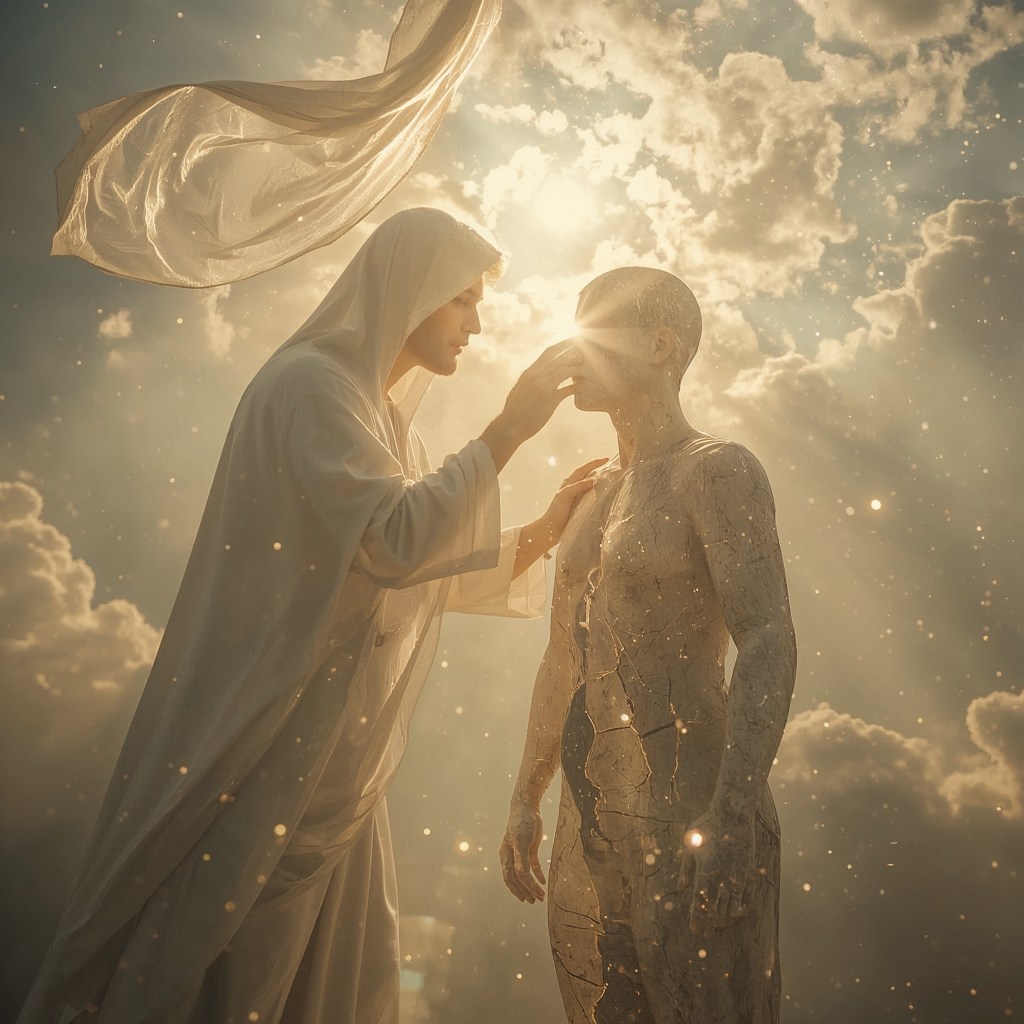
There is a great unveiling happening in the Body of Christ. An awakening. A re-formation of how we see the Father. For generations, much of the modern Church has inherited a distorted lens of God rooted in the Substitutionary Atonement Theory — the belief that Jesus had to die to satisfy the wrath of the Father.
This idea has shaped sermons, songs, prayers, and even the internal narratives of countless believers. It has produced an image of God as divided within Himself, a Father whose default posture is judgment, and a Son who must protect us from Him.
But this vision is not the gospel Jesus preached.
Jesus did not come to change the Father’s heart toward humanity.
He came to reveal it.
When Theology Creates Distance
Substitutionary Atonement, born out of medieval legal frameworks rather than Hebrew relational thinking, frames God as a cosmic Judge demanding payment. It presents salvation as a transaction — a penalty that had to be paid so God could tolerate us again.
This theology has unintentionally formed:
- believers who fear the Father,
- worshipers who approach cautiously,
- sons who live like orphans,
- and leaders who preach distance instead of union.
It explains why so many Christians love Jesus yet secretly mistrust the Father.
But the gospel is not the story of a divided Trinity.
It is the story of a unified God who stepped inside our darkness to heal us.
Jesus Came to Restore Our Vision, Not God’s
From Genesis forward, the pattern is clear: humanity hid from God — not the other way around. Sin didn’t blind God to us; it blinded us to Him.
The Cross was not the moment God finally decided to love us.
The Cross was the moment we finally saw what His love had been all along.
When the veil tore, it wasn’t a veil in God’s heart — it was the veil over ours.
Jesus came as the perfect image (Eikon) of the invisible God. He did not simply bring forgiveness — He revealed the Father.
He showed us a God who:
- sits with the shameful,
- eats with the broken,
- restores the outcast,
- defends the sinner,
- and calls every wandering heart “home.”
This is who the Father has always been.
Reframing the Cross: From Payment to Participation
The Cross was not a divine transaction.
It was a divine participation.
God stepped into our condition — our darkness, our mortality, our separation, our death — to heal humanity from within. Christ absorbed sin’s sickness, not the Father’s anger. He entered death not to appease wrath but to destroy the power of death once and for all.
The Cross reveals the depth of love, not the demand of wrath.
Salvation is not God changing His mind about us.
It is us discovering what has always been true in His heart.
The Early Church Knew This
Long before medieval legal theories, early Church fathers like Irenaeus, Athanasius, and Gregory of Nyssa taught the Gospel of Union — that Jesus united Himself to the human condition to transform it. That salvation was rooted in Incarnation, not punishment.
The Cross was not a courtroom.
It was a marriage altar.
A union.
A joining.
A restoration.
Jesus didn’t die instead of us —
He died as us, so we could live as Him.
Healing the Orphan Heart
Substitutionary thinking creates orphans — believers striving to earn approval, hoping God isn’t disappointed, and living as though the Father must be persuaded to love them.
But union reveals sons.
Sons who rest.
Sons who belong.
Sons who know their place in the Father’s heart is secure, unshakeable, and eternal.
This is the restoration Jesus came to bring — not of status but of sight.
The Cosmic Scale of Redemption
Colossians 1 tells us that in Christ, all things — not just individuals, but creation itself — is being reconciled. Heaven and Earth meet in Him. The universe is being restored through the same love that restores the human heart.
The Gospel of Union is bigger than we imagined.
It is the gospel of restored sight — for people, for communities, for creation itself.
Living With Restored Vision
When our sight is healed:
- We see the Father clearly.
Not angry. Not distant. Not divided.
But Abba — deeply present, deeply loving. - We see ourselves truthfully.
Not sinners tolerated by grace,
but new creations united with Christ. - We see others redemptively.
Every person carries divine image, even if buried beneath pain. - We see the world prophetically.
Creation is not spiraling into doom — it is groaning toward restoration.
Restored sight produces restored living.
Prophetic Declaration
Father, restore my sight.
Heal every lens shaped by fear, shame, or false theology.
Tear down every image of You that is not born of Christ.
Let me see the Father Jesus revealed —
full of love, full of mercy, full of union.
In You, I am home — fully known, fully seen, fully loved.
The Revelation Summarized
- The Cross is where love, not wrath, is revealed.
- Jesus came to unveil the Father — not to protect us from Him.
- The veil torn at Calvary was the veil over our perception.
- Salvation is not a transaction but a union — God with us, God in us, God as us.
- Restoring sight of the Father restores the world to who it was always meant to be.
This is the gospel the early Church preached.
This is the gospel Jesus embodied.
And this is the gospel that is awakening again in our time.
 In The Heart Of The Father